


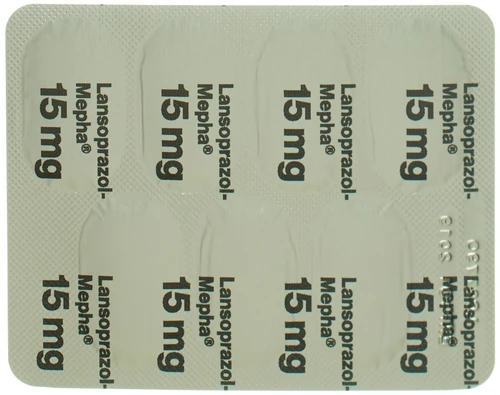
Lansoprazol-Mepha capsules
Lansoprazol-Mepha est un médicament qui atténue l'acidité gastrique.
Chez les adultes, il est utilisé
- pour le traitement d'ulcères duodénaux et gastriques,
- dans le traitement et la prévention d'ulcères duodénaux et gastriques induits par la prise de certains antidouleurs et anti-inflammatoires (appelés anti-inflammatoires non stéroïdiens, AINS),
- en combinaison avec deux antibiotiques appropriés (dont l'un doit contenir la clarithromycine comme principe actif), pour l'éradication d'Helicobacter pylori, un germe qui joue souvent un rôle important dans l'apparition d'ulcères gastriques et duodénaux,
- dans le traitement de maladie de reflux,
- dans le traitement de longue durée et la prévention de lésions de l'œsophage dues aux acides,
- dans le traitement d'inflammations et/ou d'ulcères de la partie inférieure de l'œsophage,
- en cas de syndrome de Zollinger et Ellison,
- pour le traitement de courte durée de symptômes liés à des troubles épigastriques, tels que renvois acides, brûlures d'estomac ou douleurs épigastriques.
Chez les enfants dès 12 mois, Lansoprazol-Mepha est utilisé dans le traitement des inflammations de l'œsophage (appelée œsophagite de reflux).
Selon prescription du médecin.
Hersteller
Mepha Pharma AG
Mepha Pharma AG
Zusammensetzung:
15 mg Lansoprazol (Lansoprazolum), 108.73 mg Saccharose (Saccharum), Maisstärke (Amylum maydis), Wasser, gereinigtes (Aqua purificata), Natrium laurylsulfat (Natrii laurilsulfas), 0.001 mg Natrium (Natrium ionisatum), Meglumin (Megluminum), Mannitol (Mannitolum), Hypromellose (Hypromellosum), Macrogol 6000 (Macrogolum 6000), Talkum (Talcum), Polysorbat 80 (Polysorbatum 80), Titandioxid (E171) (Titanii dioxidum (E171)), Methacrylsäure-Ethylacrylat Copolymer (1:1) (Acidi methacrylici et ethylis acrylatis polymerisatum 1:1), Kapselhülle (Kapselhülle/enveloppe de la capsule/materiale di capsula:), Gelatine (Gelatina), Wasser, gereinigtes (Aqua purificata), Chinolingelb (Chinolinum flavum (E104)), Titandioxid (E171) (Titanii dioxidum (E171))
Applikationsart:
systemisch enteral
Galenische Form:
Kapseln
Verabreichungsform:
per oral (schlucken)
Indikationen:
>18 J: Magen-Darm-Ulzera, Magen-Darm-Ulzera bedingt durch NSAR (inkl. Prophylaxe bei Risikopatienten), Eradikation des Helicobacter pylori (mit 2 Antibiotika), Refluxösophagitis (inkl. Prophylaxe), symptomatischer Reflux, Oberbauchbeschwerden, Zollinger-Ellison-Syndrom.1–18 J.: Refluxösophagitis.
Kontraindikationen:
Schwangerschaft «FI».
Empfohlene Tagesdosis (WHO):
30 mg systemisch enteral
Dosierung:
Morgens, min. 30 Min. vor dem Essen; Kapselinhalt evtl. mit Wasser, Apfel-, Tomatensaft, Joghurt, Apfelmus vermischen, Gabe über Magensonde möglich.
>18 Jahre
Ulzera: 1×tgl. 30 mg; Therapiedauer: U. duodeni: 2(–4) Wo., U. ventriculi: 4(–8) Wo.
NSAR-Ulzera: Therapie: 1×tgl. 30 mg während 4–8 Wo., Prophylaxe bei Risikopatienten: 1×tgl. 15 mg.
H. pylori: 2×tgl. 30 mg während 7(–14) Tagen, Antibiotika «FI».
Refluxösophagitis: 1×tgl. 30 mg während 4(–6) Wo.; Langzeittherapie, Prophylaxe: 1×tgl. 15–30 mg.
Reflux: 1×tgl. 15 mg während max. 4 Wo., bei wiederkehrenden Beschwerden nach Symptombefreiung: 1×tgl. 15 mg bei Bedarf.
Oberbauchbeschwerden: 1×tgl. 15 mg während max. 2 Wo.
Zollinger-Ellison: initial 1×tgl. 60 mg, dann individuell, >120 mg tgl.: in 2 Gaben.
12–18 Jahre
Refluxösophagitis: 1×tgl. 30 mg; Therapiedauer: max. 8 Wo.
1–12 Jahre
Refluxösophagitis: >30 kg: 1×tgl. 30 mg, ≤30 kg: 1×tgl. 15 mg; Therapiedauer: max. 12 Wo.
Morgens, min. 30 Min. vor dem Essen; Kapselinhalt evtl. mit Wasser, Apfel-, Tomatensaft, Joghurt, Apfelmus vermischen, Gabe über Magensonde möglich.
>18 Jahre
Ulzera: 1×tgl. 30 mg; Therapiedauer: U. duodeni: 2(–4) Wo., U. ventriculi: 4(–8) Wo.
NSAR-Ulzera: Therapie: 1×tgl. 30 mg während 4–8 Wo., Prophylaxe bei Risikopatienten: 1×tgl. 15 mg.
H. pylori: 2×tgl. 30 mg während 7(–14) Tagen, Antibiotika «FI».
Refluxösophagitis: 1×tgl. 30 mg während 4(–6) Wo.; Langzeittherapie, Prophylaxe: 1×tgl. 15–30 mg.
Reflux: 1×tgl. 15 mg während max. 4 Wo., bei wiederkehrenden Beschwerden nach Symptombefreiung: 1×tgl. 15 mg bei Bedarf.
Oberbauchbeschwerden: 1×tgl. 15 mg während max. 2 Wo.
Zollinger-Ellison: initial 1×tgl. 60 mg, dann individuell, >120 mg tgl.: in 2 Gaben.
12–18 Jahre
Refluxösophagitis: 1×tgl. 30 mg; Therapiedauer: max. 8 Wo.
1–12 Jahre
Refluxösophagitis: >30 kg: 1×tgl. 30 mg, ≤30 kg: 1×tgl. 15 mg; Therapiedauer: max. 12 Wo.

Pastiglie per la gola
Quando deglutire fa davvero male
Quando deglutire diventa improvvisamente una sofferenza e ogni respiro dà fastidio – le pastiglie per la gola promettono un aiuto rapido: calmare la gola irritata, alleviare il mal di gola e aiutare a combattere gli agenti batterici. Ma non tutte le pastiglie sono uguali. Dalle soluzioni a base vegetale ai prodotti farmaceutici, dall'effetto lenitivo a quello curativo: quali pastiglie sono più adatte a voi?

Malattia da reflusso gastroesofageo
Questi disturbi sono molto fastidiosi
Il bruciore di stomaco è ben noto: fastidioso e doloroso, ma innocuo quando il contenuto gastrico tocca brevemente la mucosa esofagea. Nella malattia da reflusso gastroesofageo il contenuto acido dello stomaco risale più frequentemente nell'esofago e provoca disturbi sgradevoli. Quali terapie sono efficaci e cosa si può fare personalmente per prevenire il reflusso?

Gastrite
Cosa può nascondersi dietro i tuoi dolori gastrici
Dalla lieve perdita di appetito, nausea e pressione nella parte alta dell'addome fino a dolori brucianti che rovinano il piacere di ogni pasto – la gastrite ha molte facce. Quali sono le cause di un'infiammazione della mucosa gastrica e come prevenirla?


