
First Aid
How easily you can save lives in emergencies
What are the most important steps in first aid?
Quick first aid is vital because valuable time is lost before emergency services arrive. First aid includes life‑saving immediate measures, the emergency call and securing the accident scene. You should also always pay attention to your own safety.
How do you make an emergency call correctly?
Call the emergency services first, otherwise too much time may be lost before the emergency doctor reaches the injured person.
Provide the rescue service with the following information: where the accident happened, what exactly occurred, how many people are injured and what kind of injuries they have.
What to do if someone is unconscious but breathing normally?
If the person is conscious, speak to them and help according to the situation. If the injured person is unconscious, the first aider should check whether they are breathing.
If breathing is normal and there is no danger of spinal injury, place the person in the so‑called recovery position to prevent choking on fluids such as blood or vomit and to stop the tongue from blocking the airway. Afterwards, the breathing should be checked regularly until the rescue service arrives.
How is cardiopulmonary resuscitation (CPR) performed?
If the person is unconscious and not breathing, cardiac arrest is imminent and immediate chest compressions are the only life‑saving measure.
Place the casualty flat on a firm surface, lean over them and press with your hands placed one on top of the other 30 times, rhythmically and firmly, on the centre of the breastbone. Then give two rescue breaths. To do this, tilt the person's head back, pinch their nose with your thumb and forefinger, take a breath and give the breathed‑in air steadily into the open mouth of the casualty over one second. Alternatively, you can close the casualty's mouth and breathe into the nose.
Alternate 30 chest compressions and 2 rescue breaths. If the first aider does not feel able to give rescue breaths, they can perform chest compressions only.
Repeat this vital resuscitation measure continuously until the person breathes again or the rescue services arrive. In the case of severe bleeding, it is also vital to stop it to prevent a possible circulatory collapse.
React quickly, act correctly – First aid tips for emergencies
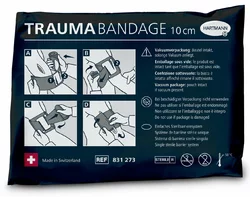
- For a bleeding, apply a pressure bandage. Cover the wound with a sterile dressing and wrap a bandage around it several times to secure it. Place a second pressure pad and wrap again. Keep the injured limb elevated if possible. If you don't have a bandage, you can simply press on the wound with a cloth.
- For a nosebleed, sit the person upright and tilt their head forward and down. Tilting the head back, as many people do reflexively, is not a good idea: blood can enter the airways or the stomach and cause nausea.
- During an epileptic seizure, remove dangerous objects (for example glasses) from the immediate vicinity of the person and protect their head if they lose consciousness. You can place a jacket under the person's head. Never try to put anything between their teeth and do not restrain them during muscle spasms! These actions can cause serious injury. If an epileptic seizure does not end within five minutes, call emergency services.
- For a burn, cool the affected area immediately with running water for at least ten minutes and, if possible, cover the wound with a sterile dressing, preferably a burn dressing. For severe burns, call emergency services.
- For frostbite, warm the hypothermic person slowly. Blood circulation in the affected areas is reduced as a protective mechanism. If the person is moved or warmed too vigorously, circulation can restart abruptly, which in some cases may lead to circulatory collapse. You can first warm the affected area with your own body heat (for example between your thighs). Warm drinks help to warm the body internally. Alcohol is not suitable.
- For a bone fracture, keep the injured part of the body still so that the casualty does not move it. If possible, pad the injured bone with rolled‑up clothing to stabilise it. A cold pack or ice pack on the injured area (but only for a closed fracture and not directly on the skin) helps with pain and prevents swelling.
- In case of aspiration (a foreign body in the windpipe blocking breathing so the person cannot cough effectively), use the Heimlich manoeuvre to prevent suffocation. Stand behind the person, encircle their upper abdomen, place a fist between the lower end of the breastbone and the navel, place the other hand on top and press forcefully and sharply into the abdomen in an inward‑and‑upward motion. This creates an overpressure that pushes the foreign body upwards.
- You can also perform the Heimlich manoeuvre on yourself if you have a foreign body blocking your airway and no one can help you. In this case place your own hands in the same area between the navel and the rib arch and press several times quickly inward and upward. If you lack strength, you can press yourself against the edge of a chair or another suitable object.
- You can always carry life‑saving information with you. For example, download a free first aid app with instructions to your smartphone, developed by the Swiss Red Cross.
- To be sure how to react correctly in an emergency, take a first aid course. The SRK and its rescue organisations Samariter Schweiz, Schweizerischer Militär-Sanitäts-Verband (SMSV), Schweizerische Lebensrettungs-Gesellschaft (SLRG) and Schweizerischer Verein für Such- und Rettungshunde (REDOG) offer appropriate training.
When it comes to first aid: imperfect is always better than nothing. With these tips you will be well prepared for an emergency situation!