
Food allergy
When ordinary foods become life‑threatening
What is a food allergy?
A food allergy is an overreaction of the body to certain food components (proteins) in foods.
In this case, our immune system targets proteins that are actually harmless and produces specific IgE antibodies against them. It is a kind of malfunction: these proteins are recognised by the messengers of our defence centre as supposedly harmful substances and these messengers trigger allergic reactions to protect the body.
This is called sensitisation. If the body comes into contact with that food again, it leads to a defensive reaction that can be mild or very severe depending on the type and amount of the allergen.
Why certain foods cause allergies in some people and not in others is still unknown. It is suspected that excessive hygiene in early childhood, early consumption of exotic fruits and use of antibiotics in infancy may serve as risk factors. Genetic predisposition also plays a significant role.

Which foods most often cause allergies?
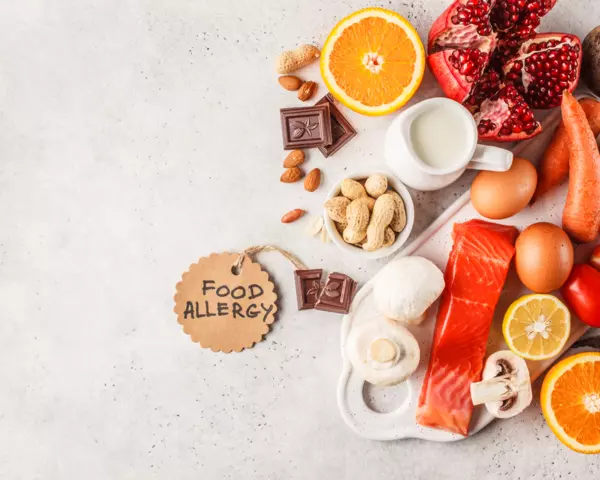
In theory, almost any food can cause an allergy. The most common allergens include chicken egg, fish, shellfish, nuts, cereals, celery, fruit, soy, cow’s milk and mustard.
One of the most dangerous food allergies is peanut allergy: even very small amounts of peanut can cause a life‑threatening anaphylactic shock in affected people. Those affected must constantly be careful about what they eat. This is particularly inconvenient when trying to relax in a café or as a guest at a friend’s. It can greatly reduce quality of life.
What role do cross‑allergies play in food intolerances?
Often a cross‑allergy is responsible for allergic complaints. It causes the typical symptoms of a food allergy, but the origin is a pollen allergy.
A cross‑allergy is considered a milder form of food allergy. The immune system confuses the allergens: in nature very similar protein structures can be found in different substances, for example the molecular structure of apple proteins resembles that of birch pollen and people allergic to birch pollen often also react to apples. When biting into an apple, the lip may swell and the palate itch, but this reaction is usually milder than in a “real” food allergy.
What symptoms do food allergies cause?
The most common complaints include skin reactions (redness, itching, hives, swelling, rash, eczema), in the mouth and throat (numb feeling on the tongue, burning, tingling or itching in the mouth and throat, swelling of the oral mucosa, tongue or lips) and in the gastrointestinal tract (bloating, nausea, diarrhoea, abdominal cramps, vomiting).
Rarely, an anaphylactic shock can occur with cessation of blood circulation and organ failure.
Symptoms can appear a few minutes up to two hours after eating and may last from a few minutes to several hours.
Keeping food allergies under control: practical tips for everyday safety
- The most important thing is to avoid allergens, that is to refrain completely from the triggers. Always read the ingredient list to make sure the product does not contain foods you are allergic to. Even seemingly harmless dishes can contain traces of allergens.
- See a doctor at the first signs of a food allergy, otherwise the severity of reactions can increase if an allergy is left untreated. The doctor can also determine whether it is an allergy or an intolerance.
- Make sure your diet does not become too monotonous. You can consult a nutritionist. Since proteins are not heat‑stable, they can often be better tolerated when cooked. Only peanuts are extremely heat‑stable.
- Try different varieties. Many birch‑pollen allergic people can, for example, tolerate apple varieties such as Altländer, Gloster, Granny Smith and Hammerstein without problems, because these varieties contain fewer allergens than others.
- When ordering in a restaurant, point out which foods you cannot tolerate and keep in mind that alcohol can intensify an allergic reaction.
- Do not eat foods that may trigger a cross‑allergy before, during or after exercise, as sport makes us more sensitive to allergies. Be aware that an allergy can worsen during pollen season. The same applies during periods of high stress.
- Hormonal changes can make allergic reactions stronger. Women should take this into account during their period.
- If the allergist has prescribed an emergency kit, always carry it with you. It consists of an antihistamine or corticosteroid to suppress the allergic reaction, an asthma spray to help breathing, and an adrenaline auto‑injector which can be life‑saving in an anaphylactic shock. Keep an additional emergency kit in places where you spend a lot of time, for example at the office.
- Always keep your mobile phone close at hand so you can quickly call for medical help in an emergency. Carry the details of your emergency contact and your allergy ID card listing your allergens.
With these tips you can keep those troublesome allergic complaints very well under control!