
Inhaler
What really helps with a cold
What is inhalation?
Inhalation means breathing in water droplets and aerosols. Water droplets reach the nose, sinuses and throat, and the small nebulised aerosol particles reach the trachea, bronchi and lungs. The aim is to prevent or treat respiratory conditions.
Inhalation devices are used to treat colds and various respiratory conditions; depending on the model they vaporise or nebulise liquid or powdered medicines and deliver active substances to the upper or lower airways.
The active substances then pass through the alveoli directly into the bloodstream. Such a treatment can quickly relieve swollen or irritated mucous membranes in the nose, lungs and throat.
What types of inhalers are there and how do they differ?
There are jet nebulisers, dry powder inhalers, metered-dose inhalers, ultrasonic and compressed-air nebulisers.
A jet nebuliser helps the active substance reach deep into the lungs. The force of a tensioned spring creates an aerosol cloud that spreads slowly and remains suspended for a long time.
A dry powder inhaler works with a powdered medicine that is inhaled using an applicator. The medicine is sufficient for a certain number of inhalations and then the dry powder inhaler is disposed of. A sufficient amount of the active substance can reach the lungs only with a strong inhalation volume. Therefore this inhaler is not always suitable for severely ill patients and for children.
Metered-dose inhalers (pressurised metered-dose inhalers, asthma sprays, COPD sprays) contain the active substance together with a propellant in a pressure container. The medicine is in liquid form. A defined amount of active substance is released as an aerosol when the spray is activated by hand. With controlled breathing the active substance can reach the lower airways. If the patient finds it difficult to coordinate the activation of the spray and inhalation, an inhalation aid is used. These are attachments for metered-dose inhalers known as “spacers”.
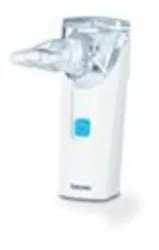
An ultrasonic or compressed-air nebuliser has a mouthpiece or a mask. The inhalation session lasts up to 15 minutes and is performed via this mask or mouthpiece. This inhaler is particularly suitable for people who struggle with the other inhalation systems.
There are also handheld inhalers for on the go, which fit in a jacket pocket and are easy to use.
What conditions are inhalers suitable for?
Inhalation devices are used for a variety of upper and lower respiratory conditions. These include not only colds, but also hoarseness, bronchitis, asthma, COPD and cystic fibrosis.
Targeted inhalation therapy humidifies the airways and makes breathing easier. Bronchial secretions are liquefied and can be coughed up more easily, while swelling of the bronchial mucosa is reduced. All this helps to reduce inflammation and to fight pathogens.
What are the benefits of child-specific inhalers?
Inhalers for children are often colourful, shaped like animals or decorated with cartoon motifs. This makes use more playful and reduces fear or resistance. Children’s inhalers are designed to be easy to use – often with a single button. Many models work with a mask, so children do not have to time their inhalation precisely.
The devices operate particularly quietly and produce a fine mist that reaches the airways gently without causing unpleasant tingling or coughing. Child-appropriate dosing and suitable attachments ensure that the exact amount of medicine reaches the child – not more and not less.
Breathe easier: top tips for using an inhaler
- For colds, hoarseness, mucus in the airways and cough you can inhale a saline solution to loosen stubborn mucus in the airways. Such inhalation promotes moisture production in the mucous membranes, has an antibacterial effect, can reduce inflammation and can also be used preventively against colds.
- For a cold it is advisable to inhale one to three times daily for 5 to 20 minutes at the first signs. This improves blood circulation in the mucous membranes and thereby activates defence cells.
- For asthma, COPD and other chronic respiratory diseases you can, under medical guidance, select the right inhalation device and appropriate therapy approaches so that medicines can be delivered directly to the lungs.
- For acute asthma attacks you can use pressurised inhalers, which act quickly and in a concentrated manner and allow the medicine dose to be inhaled as deeply as possible. For long-term therapy, powder inhalers and ultrasonic nebulisers are also suitable to treat narrowed bronchi.
- Pay attention to hygiene: hands should be washed or at least disinfected before using the inhaler.
- Clean all parts of the device thoroughly after each use. They should be washed and rinsed with warm water and, if necessary, with dishwashing liquid. Disinfectants can be used in the case of contagious respiratory diseases.
- Keep your upper body upright while inhaling. You can sit or stand relaxed.
- If you must choose between a device with a mouthpiece or one with a mask when buying, opt for the mask. Although adults can generally breathe easily through the mouthpiece, a device with a mask has some advantages. It can also be used by weakened persons and by children, as it is easier to breathe through a mask and to inhale through the nose. In addition, nebulised active substances are not lost due to incorrect breathing technique when inhaling via a mask.
Treat yourself to a suitable inhaler to help prevent infections and to do something good for your airways!