Nail polish
Beautiful hands start here
editorial.overview
What types of nail polish are there and how do they differ?
The range of nail polishes available today is very large. Every day brings new innovations in the fashion world and the nail polish industry follows suit. Nail polishes are distinguished by their appearance and their intended use. The following polishes can be classified by appearance.
Classic nail polishes are used to cover the nail plate with two or three coats. They do not require special tools or techniques for application and setting – you simply need to allow each coat time to dry.
A more durable analogue is gel polish, applied in multiple layers (base coat, polish, top coat) and cured under a UV lamp.
Glitter polishes contain sparkling elements in various shapes and sizes. They beautify the nails and give a shiny finish.
Matte polishes have no glossy effect. These are dense textures that can be applied in a single coat.
Chameleon nail polishes change colour depending on the viewing angle.
Today’s trend is Striplac – a nail polish that is easy to apply and dries in seconds. On fingernails it lasts 10 days, and even longer on toenails, with an exceptionally glossy finish. It can be removed simply by peeling off the polish. The nail is not damaged by this; it remains healthy, clean and ready for the next application.
By purpose, the following nail polishes are distinguished. Treatment polishes are a modern product that makes nail care easier. They allow you to get a pleasant manicure while nourishing the nails with the rich ingredients of a polish. In this way the nail plate is strengthened, which affects nail shine and growth.
For a quick manicure, an express polish is the right choice. It dries in one minute.
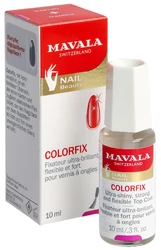
Another popular polish is the fixing top coat, which extends the manicure's wear time and strengthens the nails.
There is also "bitter" nail polish – a product designed to counter the bad habit of nail biting. The unpleasant taste reminds you to stop the habit.
For allergy sufferers, there are special hypoallergenic polishes whose composition is safe. They do not trigger allergies and can be used by anyone.
What are the main ingredients of nail polish and how do they work?
If you examine the composition of several polishes, it becomes clear that all the basic components are almost identical, although each is intended for a particular purpose. The difference usually appears in the last lines of the long ingredient lists. Generally, it is the last ingredients on that list that are responsible for certain properties of a polish.
To produce viscous polishes, nitrocellulose or its substitute cellulose acetate butyrate (CAB) is dissolved in a mixture of two solvents – ethyl acetate and butyl acetate . Nitrocellulose is a material obtained from cotton or wood fibres. The main drawback of nitrocellulose in nail polishes is that it can cause yellowing of the polish layer with prolonged wear. This drawback does not occur with its synthetic counterpart – CAB. Each of these solvents has specific properties, and their ratio determines the drying speed of the polish on the nails, in particular the viscosity of the polish. As it dries (the solvents evaporate), it leaves a completely transparent, glossy and very smooth film. Due to its brittleness and lack of elasticity, such a film does not, however, perform the function of a nail polish. A non-elastic film peels off very quickly from the surface of the natural nail, because the nail constantly changes the shape of its surface.
To make the polish elastic, plasticisers are added to the dissolved nitrocellulose mixture. The more plasticiser a polish contains, the better the quality of the polish and the longer it remains on the nail plate. The main plasticisers in polishes are phthalates, with trimethylpentanyldisobutyrate and triphenyl phosphate most commonly used. Camphor and some resins can also be used for their plasticising properties.
Sometimes polishes are formulated with alcohols and esters that accelerate the drying process. Pigments are responsible for the colour. Mica occurs in nature and gives a pearlescent sheen. Silica is needed to bind the pigments and prevent them from settling at the bottom of the polish. Its drawback is that it reduces the gloss of the coating. Titanium dioxide, a white pigment, is responsible for opacity and coverage. Bismuth Oxychloride has a pronounced pearlescent effect.
Which critical ingredients should be avoided in nail polishes?
Experts consider the following ingredients critical. Nitrosamines can form unintentionally during the manufacture of nail polish and may be carcinogenic.
The preservative formaldehyde can trigger allergic reactions.
Benzophenone is intended to protect the polish from sunlight but may negatively affect the hormonal system.
The plasticiser triphenyl phosphate (TPHP) may give a nice shine but can affect hormonal balance and health.
Many nail polishes contain the solvent toluene. This can damage the liver, kidneys and nervous system over the long term.
What are the benefits of 3-free, 5-free and 7-free nail polishes?
If you want to play it safe, when buying always choose one of these polishes: 3-free polishes contain no formaldehyde, toluene or phthalates. 4-free & 5-free nail polishes also avoid camphor, formaldehyde resins and/or colophonium. 7-free polishes are additionally vegan.
Perfectly polished: pro tips for shiny nails
- The easiest way to apply polish is the three-stroke method: first apply a strip of polish down the centre of the nail towards the tip, then repeat on the right and left sides of the nail plate.
- Nail polish should not be stored in the fridge. There is a belief that nail polish dries more slowly in the fridge. That is not true: after prolonged storage in the fridge, polish becomes stiff and flakes off more easily.
- Store polish correctly: preferably in a dark place at room temperature.
- Do not shake the bottle before applying; roll it between your palms instead.
- Before painting, dab a little petroleum jelly on the skin around the nail. This prevents residues from sticking and keeps the polish exactly where it should be.
- At the end of the manicure, be sure to use cuticle oil to care for the cuticles. Rub two drops of the oil into your palms and massage the nail beds with it. This helps nails grow healthily.
- Avoid painting your nails immediately after showering or bathing. After a long bath or shower, nails are swollen and soft. A layer of polish applied to such nails can damage them in the long term. Also, polish will not last long. Wait until nails are hard before applying polish after showering or bathing.
- For polish to last longer, the surface must be grease-free. Before applying polish all greasy residues must be removed. Nails must also be cleaned of remover and dirt particles. Use soap and water for this.
- When buying, open the bottle and look at the brush. It should be neither too short nor too long so that the brush does not touch the bottom of the bottle. The bristles should be even, uniform, without kinks or varying lengths to facilitate application.
- Pay attention to the expiry date. The polish should not be stored for more than one year.
- Use a non-acetone remover, as acetone dries nails out considerably.
There are many types of polishes and their classification is quite extensive. Let your taste and preferences guide you and, of course, pay attention to the composition.