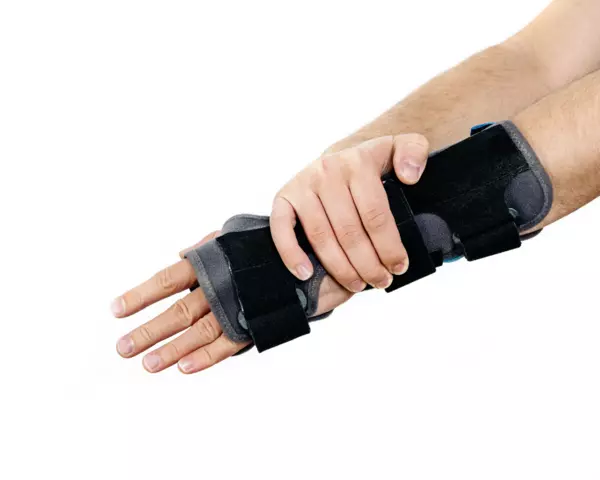
Tendons
The force that moves us from within
editorial.overview
What are the basic functions of ligaments and tendons?
Ligaments and tendons are part of the dense connective tissue. They are made of collagen fibres, elastic fibres and connective tissue cells. Their parallel fibre arrangement gives them a high tensile strength.
Working together with muscles and the skeleton, ligaments and tendons have the basic task of moving the body and stabilising it. While the muscles provide the driving force and the bones form the skeleton, ligaments and tendons act as the link between them. Their sturdy collagen structure makes them reliable partners that carry the body through everyday life.
How do ligaments and tendons differ in function and structure?
Ligaments and tendons differ in their function and location in the body. Ligaments serve to stabilise and keep joints in their correct position, whereas tendons connect muscle to bone and transmit the force generated by muscles to the bones. To transmit muscle force to the otherwise rigid skeleton, a tendon is attached to a bone at one end and to a muscle at the other.
Ligaments are responsible for stabilising joints. They guide and also limit the range of motion of joints. They connect two bones. Because of their limited elasticity, they allow only a relatively small range of motion. This is especially true for twisting movements or hyperextensions. Under excessive load they can loosen and, in the worst case, tear.
Ligaments of the gastrointestinal tract hold organs such as the liver, intestines and stomach in the abdominal cavity. The uterus is also anchored in the pelvis by strong ligaments. Ligaments can take different shapes, e.g. broad bands, thin cords or loops, depending on their function.
Tendons are made up of individual fibres that are grouped and connected together. Tendons are able to stretch by about 10 to 15 percent so that, together with the muscles, they can prevent a sudden stop of movement and thus contribute to the protection of the muscle from injury. Even the strongest muscle can only be as effective as the tendon that transmits its force to the musculoskeletal system.
What role do tendon sheaths and retaining ligaments play in the musculoskeletal system?
Tendon sheaths ensure that tendons can glide smoothly through the tissues. A tendon sheath is a fluid-filled gliding sleeve of connective tissue that surrounds a tendon. Tendon sheaths occur especially where tendons are under high tension. Tendons or tendon sheaths are additionally fixed in certain parts of the body by retaining ligaments, also called retinacula. These ligaments prevent the tendon from lifting too far off the bone when it is under tension.
A gel-like binding substance, the so-called tendon matrix, holds the tightly wound fibres of the tendons firmly together. In this matrix, which acts somewhat like a hydraulic shock absorber, water, minerals and trace elements are stored. The few tendon cells capable of producing new collagen and components for the matrix are also located in the matrix.
The fibres of the connective tissue receive little blood supply, so they are nourished by the fluid in the tendon sheaths. This happens when you move, creating a kind of pump effect that flushes the tendons with fresh fluid. For this reason, appropriate physical activity is useful to strengthen the connective tissue.

Which factors can lead to tendinitis and tendon weakness?
Painful inflammations of the tendon sheaths can occur when there is too little fluid or when the tendon is irritated and thickened. This condition, also called tenosynovitis or tendovaginitis, frequently appears as an occupational illness in people who mainly work at computers. Craftsmen, musicians, physiotherapists, climbers, rowers, table tennis players and artistic gymnasts are also at risk.
Not all tendons in our body are subjected to the same load. For example, the tendons of the foot and lower leg are particularly stressed when exposed to hard or uneven surfaces, unsuitable footwear and excessive body weight. Incorrect movements, e.g. in tennis or golf, can lead to increased wear of the tendons in the shoulder and forearm area. Unfamiliar and rarely repeated monotonous movements can also fatigue the tendons and contribute to a tendinopathy.
Surprisingly, complete immobility has a similar effect: degeneration of the tendons and loss of stability. A disturbance of tendon metabolism, as occurs in diabetes mellitus or rheumatic diseases, can also lead to premature tendon wear. The same applies to certain medications such as some antibiotics, glucocorticoids or statins.
When tendons are unusually heavily or long-term loaded, tiny tears occur in them, accompanied by painful swelling of the surrounding tissue. The tendon can no longer heal properly, scars form and it becomes more susceptible to further injuries. It becomes increasingly brittle and weak until a chronic tendon damage develops. In some people the degenerated tendon causes pain even with low loads or at rest. Others feel almost nothing for a while until a sudden movement causes a rupture.
How can the healing process of tendons and ligaments be accelerated?
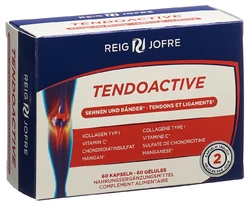
To support tendon healing, rebuild and maintain a healthy tendon structure in the long term, various micronutrients with different properties and functions are required.
Glucosamine sulfate and chondroitin sulfate act like an adhesive for tendon elasticity and the alignment of collagen fibres, leading to the stabilisation of tendon tissue. Vitamin C supports normal collagen formation, and other micronutrients such as manganese and copper help to build normal connective tissue.
How can you support your ligaments and tendons in their important work?
- It is important to improve the strength and flexibility of the surrounding muscles and to avoid a sedentary lifestyle. If the body is kept relatively rigid for long periods at a desk, compensatory movement is needed to stretch ligaments and tendons. This prevents them from stiffening and allows them to absorb necessary nutrients.
- Physiotherapists generally recommend a set of exercises for the trunk and for each limb (e.g. heel raises, leg extensions and back raises). Another recommendation is to perform neck movements in all directions.
- A combination of strength training with targeted exercises for the muscles around the joint and mobility training to promote joint movement is advisable.
- Experts recommend swimming, not too intense cycling (since intense cycling can put high load on the knees) and mobility exercises such as yoga or Pilates.
- Remember to warm up before training and to stretch and relax the muscles after training. This way you prepare your body for exercise and help prevent avoidable injuries.
- It is important to avoid overload and to increase training gradually to keep the risk of injury as low as possible. Correct sporting technique should also prevent injuries. This helps ensure optimal health of ligaments and tendons.
- A balanced, vitamin- and mineral-rich diet also contributes to ligament and tendon health. To strengthen tendons and joints or to prevent their weakening, certain vitamins, minerals and nutrients must be obtained from food.
- Protein is also important for healthy ligaments and tendons. Animal foods such as meat, fish, eggs and dairy products, but also plant foods like legumes and nuts, contain protein beneficial for ligaments and tendons.
- B vitamins support nerve function and help with amino acid formation. Vitamin B6 is found in salmon, potatoes, chicken and turkey; vitamin B12 in fish, beef and eggs.
- Magnesium is a mineral that supports muscle relaxation, bone formation and protein synthesis. In case of deficiency, joints and tendons are damaged. Nuts, wholegrain products, avocados and berries are rich in magnesium.
- Antioxidants protect tendon and muscle tissue and help regenerate connective tissue. Grape seed extract (OPC) has strong antioxidant properties. Ideally, this can not only shorten recovery time, e.g. for tendon sheath inflammations, but also rejuvenate the entire tendon apparatus. The effect is enhanced by simultaneous intake of vitamin C.
- Compounds such as gelatin or silicic acid, with a high silicon content, contribute to ligament and tendon health. Silicic acid contains silicon as its main component. Silicon promotes the body’s own formation of collagen fibres and ground substance. Silicon-rich foods include oats, millet, potatoes, maize and cauliflower.
- To cleanse connective tissue and the surrounding fluids, nettle, artichoke and potato juices are suitable. Potassium-rich foods such as apricots, bananas or potatoes are also beneficial as they have a diuretic effect and strengthen connective tissue.
- Copper and manganese strengthen the connective tissue of the tendon sheaths. Manganese is found in seafood, whole grains, oats, blueberries, spinach and flaxseed. For optimal copper supply, coconut, Brazil nuts and other nuts and seeds are beneficial.
- If you regularly experience muscle, tendon, ligament or joint complaints, consult a specialist to determine whether an underlying condition or disease is present. Your doctor knows how to proceed in such cases.
A balanced diet, regular exercise and targeted supplementation are secret weapons to protect ligaments and tendons from overload and to keep them healthy for a long time!