Orthosis
What to do after a sports injury
What is an orthosis and how does it work?
The term orthosis is derived from the Greek word «orthos» and means “correct, straight, upright”. It is a medical aid that holds the injured joint, muscle or bone in a specific position or absorbs the forces acting on those structures.
This externally applied orthopaedic device supplements the shape and function of the injured body part, relieves it and stabilises it. This function of the orthosis is very important for healing, because otherwise the injured body part may be loaded too early or incorrectly, which can lead to damage. Possible consequences include chronic pain, increased susceptibility to injury, premature wear of joint cartilage or the development of osteoarthritis. Poorly fitting orthoses can also cause problems such as skin or tissue damage from pressure or rubbing, circulation disorders, incorrect loading, as well as irritation and discomfort.
There are industrially manufactured conventional orthoses in various sizes that can be adjusted only slightly, and custom-made orthoses. Unlike a plaster cast, the surrounding muscles continue to work, and the muscle mass that the body would lose through complete inactivity is preserved. This accelerates regeneration and allows the joint to bear weight again sooner. This reduces the risk of a re-injury immediately after the first injury has healed.
What types of orthoses are there and how do they differ?
One distinguishes compression sleeves (bandages) and rigid orthoses (splints) with Velcro fastenings and clips. Compression sleeves work by compression: as the muscles contract and relax against the knitted fabric, an alternating pressure is created during movement that massages the soft tissues. This massage relieves pain and stimulates metabolism. Swelling can also subside more quickly. At the same time, sensory receptors in the skin, soft tissues and muscles are stimulated across the entire area covered by the sleeve. This increased sensory input activates sensorimotor processes and contributes to stabilising the affected body part during movement.
Splints are made from firmer materials to guide and limit the range of motion precisely. If knitted parts are present, they are tighter than those in compression sleeves. Such a stable splint ensures guidance, correction and stabilisation of the joints. This type of orthosis provides a stable force closure around the affected part, relieves it, protects against faulty movements and reduces pain.
What materials are used for orthoses?
Orthoses can be made from a variety of materials. The most common are plastics, metals, fabrics and silicones.
To stabilise the damaged body part as effectively as possible, orthoses are constructed with splints, cords or straps with Velcro fastenings. The range of motion can be adjusted depending on the type of orthosis.

For which body parts and injuries are orthoses suitable?
The most commonly used orthoses are ankle orthoses, knee orthoses, foot orthoses, wrist orthoses, elbow orthoses, finger orthoses, cervical collars and scoliosis braces.
The U-shaped ankle orthosis is worn after sports injuries such as ligament tears or Achilles tendinitis. It stabilises part of the lower leg and only moderately restricts freedom of movement.
The knee orthosis is used after ligament and muscle injuries as well as after operations.
The foot orthosis complements physiotherapy treatment for foot deformities and supports the foot and toes for correct walking.
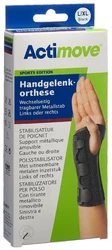
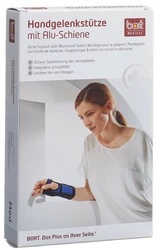
The wrist orthosis is used for injuries or pain and swelling in the hand area. Including the thumb can provide additional stabilisation.
The elbow orthosis is worn for inflammations to protect the muscles, tendons and their insertions.
The finger orthosis stabilises and corrects one or several finger joints and is usually made individually.
A cervical collar is worn after a whiplash injury or after a fracture of the upper cervical vertebrae.
The scoliosis brace is used to treat spinal curvatures during the growth period.
Using orthoses correctly: practical tips for more comfort and effectiveness
- Whether an orthosis is necessary and which one suits you should be discussed with your doctor. He or she will examine your complaints and conditions thoroughly.
- How long an orthosis must be worn depends on the injury and everyday stresses. To ensure you use the orthosis correctly, your doctor should inform you as precisely as possible about how long and in which situations you should wear or remove it.
- For custom-made orthoses, the orthopaedic specialist will instruct you on correct application, use and care of the orthosis. It is important that you master putting the orthosis on correctly.
- To avoid skin damage, a thin, absorbent garment should be worn between the skin and the orthosis. There are special garments that wick moisture away from the skin quickly. Watch for unwanted creasing.
- If your orthosis has a compressive effect, avoid wearing it at night. Otherwise, blood congestion may occur and skin nerves can be damaged.
- Orthoses that immobilise the joint after an injury should also be worn at night. An inadvertent movement during sleep can otherwise damage incompletely healed ligaments and tendons again. For showering or personal care, the splint can be removed or a shower cover can be used.
- To extend service life, the orthosis should be cleaned regularly with water or disinfected with special sprays.
- The orthosis must not cause pain, numbness or tingling. If the skin reddens or parts of the body turn bluish or white, this is a warning sign and must be discussed with your doctor immediately.
- Orthoses should be checked regularly for fit and functionality. If complaints worsen, the old model may no longer fit. In this case it may be necessary to obtain a new splint with greater support that relieves the joint more effectively at the affected areas.
- It is also possible to swim while wearing an orthosis. The requirement is, however, the use of a special orthosis in which all components are water- and corrosion-resistant. These waterproof orthoses are also unaffected by chlorine and salt water.
A well-fitted orthosis provides stability, correction, fixation and pain relief and gives you more confidence in daily life after an injury!