Wild Yam
This tuber makes you younger, happier and pain‑free
editorial.overview
Which ingredients make the yam root so valuable?
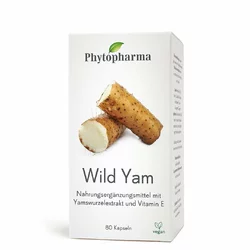
Wild Yam, or yam root (Dioscorea villosa), originates from West Africa, where "yam" means "to eat", which is why it is also called the breadroot. Above all, the root of this climber, which can reach several metres in height, is popular as a food. Its taste resembles that of sweet potatoes.
Yam root has a high starch content and contains proteins, fats, B vitamins, vitamin A, vitamin C, niacin, folic acid and the resin alkaloid dioscorin. Wild Yam is also rich in minerals (potassium, magnesium, phosphorus and calcium) and trace elements (iron, copper, manganese, zinc and fluoride), which are involved in important metabolic processes.
The most effective constituents of this wonder tuber are probably the saponins diosgenin and dioscin. Diosgenin is similar to endogenous steroid hormones and is a starting material for the production of important hormones that are responsible for the female cycle and the regulation of both female and male hormonal balance. Through the synergistic action of the yam root's constituents, anti‑inflammatory, circulation‑promoting, rejuvenating and antispasmodic effects can also be achieved.
How does Wild Yam work for women's hormonal complaints?
Yam root acts like a natural hormone. Because of its progesterone‑like effect, Wild Yam can help with many complaints caused by an imbalance between oestrogen and progesterone. These include mood swings and depressive tendencies during menopause, premenstrual syndrome (PMS) and menstrual problems. The pain‑relieving and antispasmodic effect of yam root is a natural remedy for lower abdominal pain during menstruation.
Almost all of these complaints are due to oestrogen dominance: even if a woman in menopause has low oestrogen, there may be relatively much less progesterone in the body compared with the remaining oestrogen. This issue does not only occur in menopause: chemicals in the environment have oestrogen‑like effects. That means we are all affected by oestrogens — or by substances that can mimic oestrogenic activity. Breast tension, water retention, sleep disturbances, fibroids and cysts, migraine, acne and hair loss are signs of oestrogen dominance in women. Wild Yam gently counteracts oestrogen dominance through progesterone‑like diosgenin.
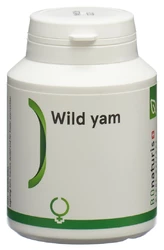
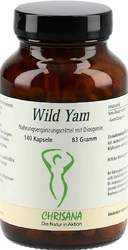
Can yam root also help men with health issues?
Men who suffer from oestrogen dominance and therefore experience mood swings, restlessness or reduced sexual desire may also benefit from the progesterone‑like effect of yam root.
For prostate health, the interplay of testosterone, oestrogens and progesterone is particularly important. With age this interplay can get out of balance. Taking yam root capsules can support prostate function and counteract hormonally driven prostate enlargement.
What role does yam root play in osteoporosis and heart health?
Yam root can be used for the prevention of osteoporosis. According to a study by Harvard Medical School in Boston, Wild Yam helps stimulate the proliferation of bone‑forming cells while preventing their excessive breakdown, as seen in osteoporosis.
Furthermore, it improves calcium uptake into bone tissue and promotes the formation of collagen I and laminin B2, which are of great importance for bone formation.
Wild Yam is also used for atherosclerosis: it can protect blood vessels from deposits, as shown by a study from China Medical University. In the group that received Wild Yam, deposits were significantly reduced. Hyperlipidaemia (disturbance of lipid metabolism) can induce oxidative stress, which is relevant to atherosclerosis pathogenesis. Administration of powdered antioxidant yam rhizome reduced this oxidative stress and alleviated atherosclerosis. The anti‑inflammatory properties of yam root can, according to a study published in the Journal of Analytical Methods in Chemistry, be used in the treatment of arthritis.
What other health benefits does yam root offer?
Yam root is also promoted as an anti‑ageing remedy for the skin: diosgenin is said to promote production of the hormone DHEA, which acts against ageing.
In addition, a study concluded that yam root also leads to an improvement in cognitive abilities. The diosgenin it contains improved the memory performance of test subjects. This applied both to healthy brains and to brains of Alzheimer's patients.
Wild Yam also stimulates digestion by increasing bile production, and it helps lower an elevated blood sugar and cholesterol level.
Back to balance naturally: tips for using Wild Yam for wellbeing and hormonal balance
- As a food, yam root is prepared like a potato: boiled, baked, fried, deep‑fried, puréed or mashed.
- There are many ready‑made preparations of wild yam: in the form of capsules, creams or vaginal gels.
- In the fertile years, Wild Yam is used from ovulation onwards. It is not used throughout the entire cycle.
- For menopausal complaints, the capsules are taken once daily. They typically contain 500 mg of yam root extract.
- The cream or gel is applied once or twice daily in a cherry‑kernel to hazelnut‑sized amount to the breasts, abdomen, arms or inner thighs. After absorption of the cream or gel, wait at least one hour before showering. The rule of thumb here is also: use from ovulation until the next menstruation.
- For cramps and gastrointestinal complaints, a tea made from yam root helps: for one litre, simmer 25 g of yam root for 30 minutes over low heat.
- When purchasing, look for a high‑quality product without artificial preservatives and ask your doctor about the correct dosage.
- Rarely, intolerances or allergies may occur. If you experience digestive complaints such as bloating, abdominal pain, diarrhoea or constipation after taking yam root, discontinue use.
- During pregnancy the root is not recommended, as it is not known to what extent this phytohormone affects natural hormone production during pregnancy.
Bring your hormonal balance back with this wonder root!