Hair brush
The most important care product for your hair
Brush or comb hair?
The decision whether hair is better brushed or combed is a basic consideration in hair care and can have far-reaching effects on the health and appearance of the hair.
Combs, especially those with widely spaced teeth, are ideal for gently detangling fine or thin hair. They allow a gentle treatment to avoid breakage, particularly when hair is wet. Combs are also useful for distributing care products evenly.
Brushes, on the other hand, are better suited for thick or frizzy hair, as they glide more easily through denser hair structures and help loosen knots. They are also suitable for straight hair to enhance shine. However, it is advisable not to use brushes on wet hair, as this can damage the hair structure and lead to breakage.
The choice between comb and brush is therefore not just a matter of personal preference, but should be matched to the hair type and its needs.
Which hair brush suits which hair?
For care and styling of different hair types, it is crucial to find the right, high-quality hair brush.
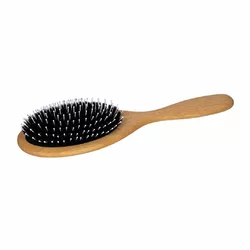
For long, straight hair, paddle or flat brushes are ideal. These brushes have a wide surface that gently glides through long hair and makes it smooth. Models with rounded wooden bristles or rubber tips are particularly gentle on the hair and, by massaging the scalp, promote hair health. When blow-drying, they also help achieve a smooth and elegant look.
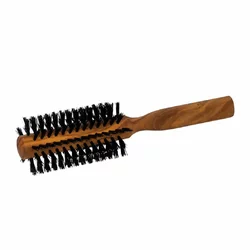
Fine, thin hair requires a very different approach. A vented volume brush is recommended here: it is hollow inside and allows warm air to pass through during drying to give the hair more body. Ionic brushes can help prevent static, and a round brush with boar bristles adds extra shine and smoothness. The range offers a wide selection of brushes, including olive wood models, to meet individual needs.
For curls, curl brushes with widely spaced teeth are ideal because they gently detangle hair without pulling. After detangling, a paddle brush with widely spaced bristles can be used to prepare and dry the curls gently. Tail combs are also particularly useful for precise styling.
For short cuts, skeleton brushes are suitable; their notches allow quick drying and add volume. Round or ceramic brushes are also a good choice as they distribute heat evenly for efficient styling.
Detangler – Which brush for detangling?
Detangler brushes are specifically designed to remove tangles gently and painlessly. They feature bristles of varying lengths that move smoothly through detangled or knotted hair without irritating the scalp. Such a brush is especially helpful for daily care.
These brushes are not only a practical styling tool but also contribute to hair quality by minimising split ends. In addition, the bristles massage the scalp, which promotes circulation and supports hair growth.
There is a wide variety of detangler models for different needs. Some brushes have a handle, others are more compact and handleless, fit into any bag and are ideal for travel. These brushes are suitable for all ages and particularly popular with children as they reduce the unpleasant pulling during brushing.
Detangler brushes are suitable for all hair types and lengths. They can be used on straight, thick, fine, curly or frizzy hair, both wet and dry. For particularly sensitive hair or hair with extensions, detanglers are also useful because they do not attack the bonds and thus extend their durability. They also help protect against static and contribute to a smooth, shiny appearance.
Why does the brush make hair static?
Static charge often occurs during combing, and the use of the right brush plays a decisive role.
When combing with metal or plastic brushes or combs, the outer layer, the so-called cuticle, becomes roughened. This causes the release of negative particles, electrons, and the accumulation of positive charges. Since like electrical charges repel each other, the now equally positively charged hairs cause the strands to separate and stand away.
This physical reaction is more pronounced with dry or fine hair, as these hair types contain less moisture and therefore conduct electrical charge less well. Oily or wet hair becomes charged less quickly because water and oil increase electrical conductivity and thus dissipate the charge better.
To avoid static build-up, brushes or combs made from materials such as carbon fibres, nylon, Celcon or wood are preferred. These materials act antistatically and help protect the cuticle. Brushes with natural bristles are also a good option as they are gentler on the hair and reduce static build-up.
Should hair be brushed daily?
Daily brushing, around two to three times a day, can have many benefits depending on hair type. Before washing, it removes dirt and skin flakes; after washing, it distributes natural nourishing substances evenly. This makes the hair smoother, the roots appear less greasy and it gains a healthy shine.
In addition, brushing stimulates blood circulation, which promotes hair growth. However, it should not be overdone to avoid breakage, especially in fine hair which is more sensitive to excessive stress. In cases of irritated scalp or dandruff, care should also be taken as excessive brushing can worsen these issues.
Choosing the right brush and caring for it: best tips
- For thick, unruly hair use stiffer brushes made of harder materials. Massage brushes made of plastic or metal and combs with wide teeth are well suited.
- For weak and fine hair choose soft massage brushes with natural bristles or plastic bristles.
- For damaged, brittle and dry hair, brushes with sparse teeth are suitable.
- The length of your hair also determines the length of the bristles. The longer your hair, the longer the bristles of your brush should be. This makes combing easier.
- If you have dry hair, make sure your brush has as soft and flexible bristles as possible.
- For oily hair opt for a brush made of wood or horn.
- For fine and straight hair you can use any massage brush. These brushes keep the hair structure intact. The same brushes are also worthwhile in case of hair loss.
- For thick hair use a wide brush with natural bristles. It is perfect for brushing and separating individual strands as effectively as possible.
- Remove detached hairs from the brush daily and wash your hair brush thoroughly once a week. Shampoo can be used for this.
- If you use a brush with natural bristles, rinse it daily.
- If you notice cracks and splinters on the bristles or teeth, replace the accessory as soon as possible.
- Even if you care for your brush well, you should not use it for longer than six months. Even if your brush is still in good condition, replace it semiannually with a new one.
Only when you have chosen the right brush will you notice positive results in your hair and the brush will fully satisfy its user.