
Moths
The little enemy that comes through your window
How do moths get into the apartment?
Moths enter apartments in various ways, often through everyday activities that are hard to avoid. Clothes moths frequently come in through open windows or with second‑hand clothes. They are especially attracted to textiles where they can lay their eggs. Inside the home they look for dark, quiet places such as wardrobes or drawers in which to reproduce.
Pantry moths, on the other hand, are usually brought in via foodstuffs already contaminated with eggs or larvae. This type of moth is drawn to open or poorly sealed food containers.
They prefer to lay their eggs in dry foods such as flour, grains and nuts, which they regard as ideal food sources for their larvae. Moth eggs are extremely small and are often overlooked even during regular hygiene checks, allowing contaminated products to reach the market.
How to distinguish pantry moths from clothes moths?
If you suddenly find moths in your home, it helps to be able to distinguish pantry moths from clothes moths so you can take the right control measures.
Pantry moths, such as the flour moth and dried‑fruit moth, are usually identified by their size and colouring. They can have a wingspan of up to 20 millimetres and a body length of 4 to 10 millimetres. The forewings range from silvery grey to ochre yellow, while the hindwings are often pale grey. These moths prefer warm, heated rooms, especially kitchens. They are found worldwide and feed on a variety of dry foods such as flour, cereals and dried fruit.
Clothes moths are somewhat smaller, with a wingspan of up to 16 millimetres. They are characterised by a uniform straw‑yellow colouring with no visible patterns or spots on the wings. These moths are often found in dark, quiet places such as wardrobes or under carpets, where they feed on textiles containing animal fibres like wool and silk. They are particularly light‑averse and avoid bright rooms.
Another difference lies in habitat and reproduction. Pantry moths can lay up to 600 eggs and their larvae develop primarily in food, whereas clothes moths lay between 50 and 250 eggs and their larvae feed on textile fibres.
How long do moths live in the apartment?
Their lifespan is surprisingly short. Adult moths typically live only about two weeks. This short lifespan is designed to allow moths to mate quickly and lay eggs to reproduce. The entire life cycle from egg to adult moth can, however, take several weeks to months depending on environmental conditions such as temperature and food availability.
A moth infestation in a home can persist for several months, especially if larval pupation is prolonged by environmental conditions. In heated rooms, moth development can be accelerated by warmer temperatures, so several generations may appear in a single year.
How can you fight moths using scents?
There are several natural repellents that many households already have or can easily obtain to fight moths with scents.
The scent of lavender is pleasant to people but avoided by moths. Lavender sachets or cloths soaked in lavender oil can be placed in wardrobes to deter moths.
The strong smell of cedarwood also repels moths. Cedar blocks or rings can be placed in wardrobes to keep moths away.
Another strongly scented remedy against moths is cloves. Small sachets with whole cloves can be distributed in cupboards and drawers.
Peppermint oil is known not only for its refreshing scent but also for its moth‑repellent properties. A few drops on a cotton cloth or in a diffuser can help keep moths at bay.
Do sticky traps help to control clothes moths?
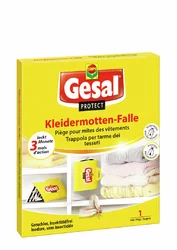
Sticky traps are a useful tool when dealing with clothes moths, especially to assess the extent of an infestation. These traps use odourless sexual lures (pheromones) typically emitted by female moths to attract males. The males are drawn to the lure and become stuck to an adhesive surface.
The main advantage of sticky traps is that they are harmless to people and pets. They can be easily placed in wardrobes where they actively catch males and thus disrupt the moths' mating cycle. This can help reduce reproduction of the moth population.
However, they also have drawbacks. They mainly catch males and have no effect on females or on existing larvae, which cause the actual damage to textiles.
So if catching males confirms an infestation, additional measures are required to tackle the problem fully. These include thorough cleaning and, if necessary, treatment of affected textiles to remove larvae and eggs.
Sticky traps therefore provide a good first line of defence and are helpful for monitoring infestations, but should be used as part of a broader moth‑control strategy.
How to prevent pantry moths?
To prevent pantry moths, it is necessary to optimise food storage conditions. Moths prefer a warm, humid environment, which often occurs in kitchens during cooking.
Food should therefore be stored cool, dry and only for short periods. It is advisable to use airtight screw‑top containers or containers with effective seals, as simple tin lids often do not provide sufficient protection.
Regular inspection and cleaning of pantry cupboards and spice racks is essential to detect signs of infestation early, such as chewed flour, holes or cobwebbing.
Also, older food should always be used before newly purchased items to minimise storage time. Storing particularly vulnerable foods, like nuts, in the fridge can also help prevent an infestation.
Fight and prevent moths at home: useful tips
- Find the nest. Check bedrooms and children's rooms in particular, as wardrobes located there attract moths. Look for holes in clothing and small webbing.
- If you find the nest, keep all doors closed to prevent spread. Ventilate briefly with cross‑ventilation and do not leave garments lying around.
- Wash affected clothing at the hottest temperature possible. Afterwards place the clothing in the freezer for at least three days or, in winter, on the balcony to kill remaining eggs and larvae.
- Empty all wardrobes and vacuum them thoroughly, especially the crevices. Dispose of the vacuum bag in an airtight manner and clean the cupboards with vinegar cleaner.
- Check your pantry and kitchen cabinets, especially warm areas. Look for holes in packaging and contamination in foodstuffs.
- Remove the nest. Vacuum up larvae and moths and dispose of the bag airtight.
- Discard infested food and inspect sealed packages for holes. Use airtight containers made of glass, ceramic, stainless steel or hard plastic for uncontaminated supplies.
- Use home remedies: lavender, cedarwood and cloves deter moths. Place these in the wardrobe or other affected spots.
- Maintain carpets and vacuum them regularly, especially under cupboards.
- Wash curtains, cushions and small rugs at 60 degrees and clean your washing machine regularly.
Moths in living spaces are a common problem that can be effectively controlled with appropriate measures. The right combination of prevention and control helps protect homes from these unwelcome pests.